The staff carefully select songs with repetitive words and phrases and predictable actions. These songs are frequently re-written to increase repetition, simplify language, or add parts. While singing, the children practice using all communication modes including speech, gestures and use of augmentative and alternative communication and assistive technology (AAC/AT). We emphasize actions and add fun sound effects to ensure children remain engaged as they learn the parts and sequence of the song in this therapist-led activity.
Children often naturally move their body in rhythm with the music, which makes it easier to encourage actions related to the words in the songs. Children love to sing songs over and over and this provides them more opportunities to learn the words. It also ensures that children using assistive technology (AT) have many chances to practice operational skills such as activating switches or retrieving messages. Once they learn their part, children have additional opportunities to practice timing their responses in a fun, engaging context.
The song ‘5 Little Monkeys Jumping On the Bed’ is a favorite during the Doctor theme. Children enjoy the actions and gestures, and acting the parts of the monkeys, the mother and the Doctor. This song provides multiple opportunities to count from one to five and inspires the use props from the dramatic play. The actions in the song motivate children to be very active in their independent, upright, hands-free walkers.
We use multiple tools in the design and implementation of our preschool curriculum. This activity is guided by:
Language Focused Curriculum for Preschool by Betty H. Bunce (2010) serves as a resource for our staff in determining age appropriate expectations and a developmentally sound continuum of goals and objectives.

The California Department of Education has adopted a set of learning standards or foundations that describe optimal growth, development and learning for all children and provides strategies for achieving each goal, best teaching practices and considerations for a well-designed educational environment. The Bridge School implements these standards in our preschool program. This activity addresses the following goals and objectives found in the California Department of Education Preschool Learning Foundations.
This tool serves two purposes in the preschool planning process. It is used to monitor student outcomes and to inform curriculum development. As we rate the various measures or learning progressions, we can document the tools and supports being used to achieve progress. This activity addresses the following indicators from the Desired Results Developmental Profile Access (DRDP-Access).
Repeat with 4,3,2 monkeys then 1 monkey jumping on the bed. Monkeys who ‘fell off’ can join circle and do parts from circle. When there are no more monkeys they can pretend to go to sleep and Mama and the Doctor can take a turn jumping on the bed!
The instructional routine for Music Time is:
Music is designed to extend over several days.
Day 1: Watch movie clip
Introduce song by talking through script with children trying all the parts. Show and repeat actions and gestures, and emphasize sound effects. Watch for preferences; note who likes to count, who likes to jump and who prefers to talk on the phone. Be aware of what gestures the children naturally use and determine which may need adapting.
Day 2: Give children parts
Provide simple SGDs. Cue children to take turns. Children may begin to anticipate and initiate turns.
Day 3: Repeat previous days script and reduce cues
Children might want to switch roles and they may begin to perform more actions, gestures while also performing their part. Children may enjoy varying song. Try picking a different part of the body to ‘bump’.
This child is pointing to a photo of parts of the body. In the 5 Little Monkeys Jumping On the Bed song, the monkeys bumped their heads, but children may like to sing another version where they pick what part they bump (e.g., 1 fell off and bumped his leg).
We use this display in the dramatic play center and for different songs like the Hokey Pokey.
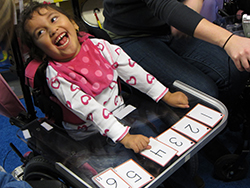
This is an example of a visual support for counting. The student points to the number card as she recites numbers.
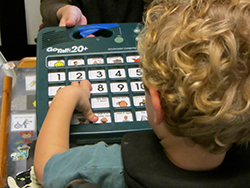
Some students may use an SGD to count.
Lines and sound effects to record:
Monkeys’ part
Depending on skills children could have more than one part and also perform gestures. This part is most dynamic and requires most coordination between performing actions, gestures and speaking parts.
Mother
This part is more predictable and repetitive, good for children with less experience taking turns.
Doctor
This part is the most predictable as it follows the mother’s part and comes at the end of the stanza, good for children who need the most support.
Counter
Amory, H. The Usborne First Thousand Words (Revised Ed.). Tulsa: Educational Development Corporation.
http://www.edcpub.com/
Bunce, B.H. (2008). Early Literacy in Action: The Language Focused Curriculum for Preschool. Baltimore: Paul H. Brookes Pub. Co.
http://products.brookespublishing.com/Early-Literacy-in-Action-P217.aspx
California Department of Education Preschool Learning Foundations – http://www.cde.ca.gov/sp/cd/re/psfoundations.asp
Christelow, E (1989). 5 Little Monkeys Jumping on the Bed. New York: Houghton Mifflin, Harcourt.
The Desired Results Developmental Profile (DRDP) Access – http://www.draccess.org/
Mama Lisa’s World of International Music and Culture 5 Little Monkeys – http://www.mamalisa.com/?t=es&p=786&c=23
Musselwhite, C. (uploaded 2009) Singing to Learn – http://www.youtube.com/watch?v=9Yhw-XmDS04
CDs available at http://www.aacintervention.com.
Simple Songs (uploaded 2007) 5 Little Monkeys! – http://www.youtube.com/watch?v=ZhODBFQ2-bQ
Source for sound effect sounds: Audio Sparkx – http://www.audiosparx.com
Each contribution makes a difference in the lives of our children. Visit our secure donation page and fill out the form to make your secure online donation.

The Bridge School
545 Eucalyptus Avenue
Hillsborough, CA 94010-6404
T: 650-696-7295
F: 650-342-7598
© The Bridge School